The definition you won't get from a marketing team
Let's get something out of the way first.
If you google "What is AI?", you'll find definitions crafted by the marketing departments of the biggest tech companies on the planet. They'll show you chatbots writing poetry, robots performing surgery, and self-driving cars navigating traffic. The implicit message is clear: AI = large language models = the future of everything.
That's not wrong, exactly. But it's like defining "engineering" by showing a SpaceX rocket landing on a barge. Technically accurate. Wildly unrepresentative of what 99% of engineers actually do on a Monday morning.
Here's a more honest definition:
The honest definition
Machine learning is a set of algorithms that find patterns in data — patterns that are too complex, too subtle, or too tedious for a human to specify manually.
That's it. No robots. No sentience. No sci-fi. Just pattern recognition, automated.
And here's the part the headlines skip: the most useful ML algorithms for engineering work are not large language models. They're not chatbots. They're not image generators. They're methods with names like Random Forest, XGBoost, and Gaussian Process Regression — algorithms that take your process data, your simulation results, or your sensor readings, and find relationships you didn't know were there.
These algorithms aren't new. They aren't glamorous. And they don't make for viral LinkedIn posts. But they solve real engineering problems, every day, on ordinary laptops.

So what does "finding patterns" actually mean?
You already find patterns in data. Every engineer does.
When you look at a scatter plot of tensile strength versus tempering temperature and say, "there's clearly a sweet spot around 450°C," you've just done what ML does. You looked at data. You spotted a relationship. You used it to make a prediction: "if I temper at 450°C, I'll probably get the best strength."
The difference is scale and complexity.
You can spot a pattern between two variables on a plot. Maybe three. But what if the relationship depends on 15 variables interacting simultaneously — alloy composition, heating rate, hold time, cooling method, ambient humidity, and ten other parameters? What if the relationship isn't a clean curve, but a jagged, non-linear mess with interactions you'd never think to look for?
That's where ML comes in.
A machine learning algorithm does the same thing you do when you eyeball a scatter plot — but it does it across dozens of variables, thousands of data points, and arbitrarily complex relationships, in seconds.

The core idea: learning from examples
Every ML algorithm, no matter how fancy, does the same fundamental thing:
1. You give it historical data — inputs and the corresponding outputs. For example: 500 rows of CNC machining parameters (feed rate, spindle speed, depth of cut) and the resulting surface roughness for each run.
2. The algorithm searches for a pattern — a mathematical relationship between those inputs and outputs. It tries different rules, measures how wrong it is, and adjusts. It's iterative, like converging on a solution in FEA by refining the mesh until the error is small enough.
3. Once trained, you use the pattern to make predictions on new data — you feed in a set of machining parameters the model hasn't seen before, and it predicts the surface roughness. No additional simulation. No physical test. Just the pattern it learned, applied to a new situation.
That's the entire concept. Everything else — every algorithm name, every technique, every piece of jargon — is just a different way of doing step 2. A different strategy for searching for patterns.

An analogy you already understand
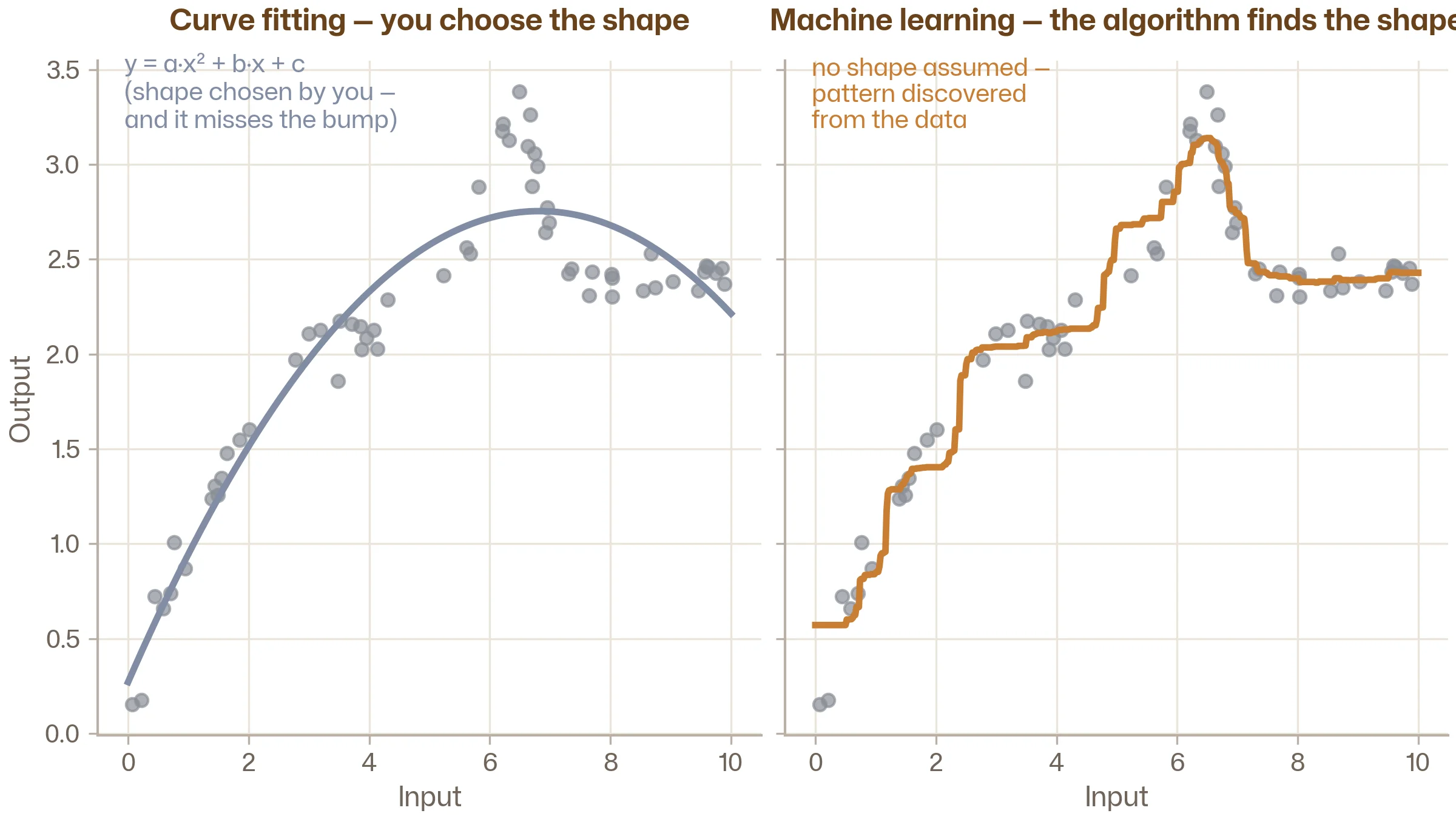
If you've ever done curve fitting — in Excel, MATLAB, or any other tool — you've done a simple version of machine learning.
In curve fitting, you choose a function (say, a polynomial), and a method (say, least squares) finds the coefficients that best match your data. Then you use that fitted function to interpolate or extrapolate.
Machine learning is the same idea, generalised:
| Curve fitting | Machine learning | |
|---|---|---|
| You choose | The function shape (linear, quadratic, exponential...) | The algorithm (decision tree, random forest, neural network...) |
| The method finds | The best coefficients | The best pattern (could be a set of rules, a tree of decisions, or millions of weights) |
| You use it to | Predict a value from the fitted curve | Predict an output from new input data |
| Limitation | Works well for 1–3 variables with a known relationship shape | Works for dozens of variables with unknown, complex relationships |
The key difference: in curve fitting, you decide the shape of the relationship. In ML, the algorithm figures out the shape. That's why it can handle problems where you have no idea what the underlying relationship looks like — which, if you're honest, is most real-world engineering problems once you go beyond two or three variables.
What kinds of patterns can ML find?
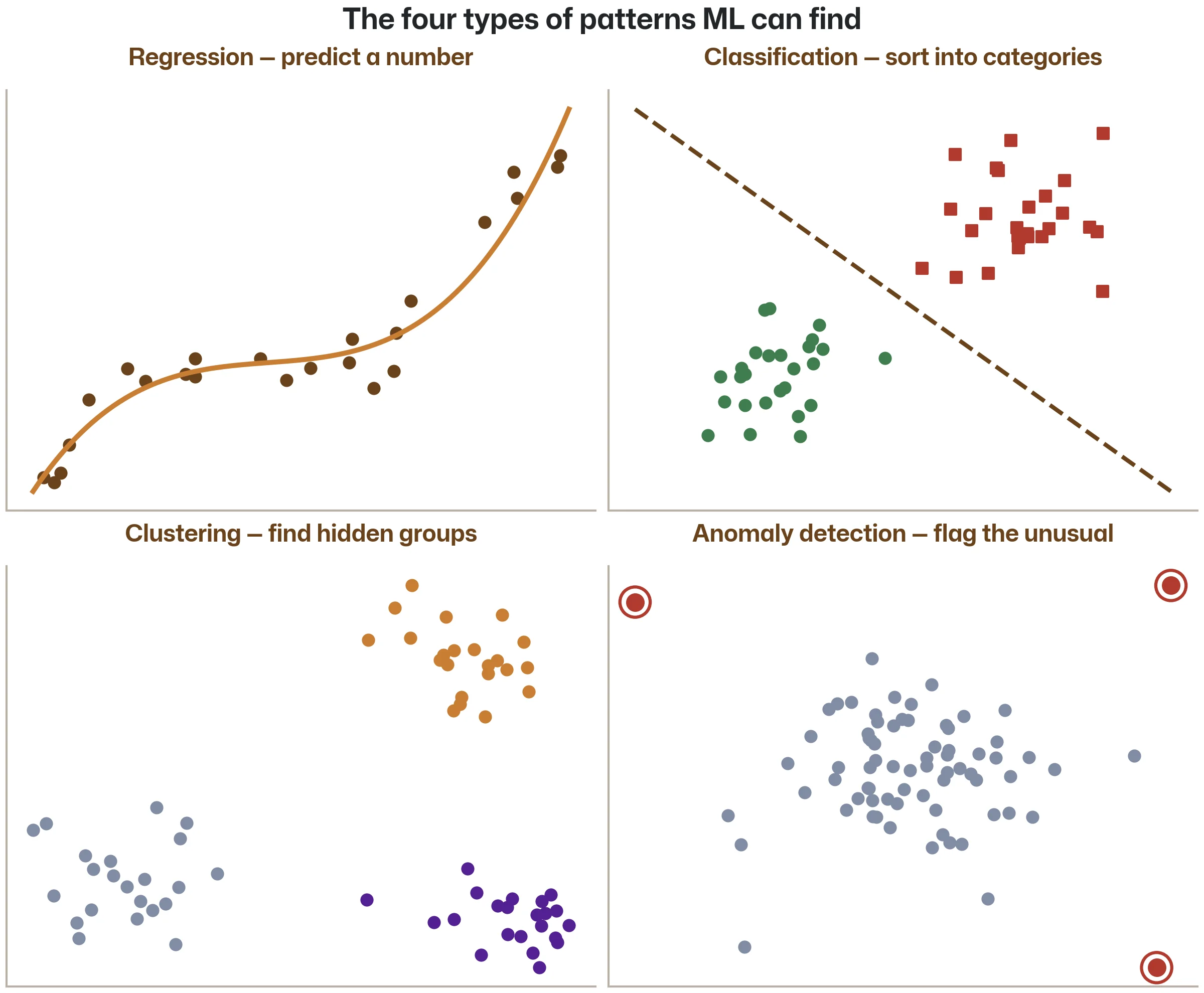
ML algorithms don't just fit curves. They can find several fundamentally different types of patterns:
Predicting a number — given a set of process parameters, predict the expected surface roughness, the stress at a critical point, or the energy consumption of an HVAC system. This is called regression, and it's the ML version of curve fitting on steroids.
Predicting a category — given sensor readings and measurements, predict whether a part is good or defective, whether a bearing is healthy or degraded, or whether a weld passes or fails inspection. This is called classification.
Discovering hidden groups — given a mountain of unlabelled sensor data, discover that your machine has four distinct operating modes that nobody documented. Or that your material test samples naturally fall into three families with different properties. This is called clustering.
Spotting anomalies — given what "normal" looks like, flag when something is unusual. A vibration pattern that doesn't match any known operating mode. A batch of chemical process data that looks different from all previous batches. This is anomaly detection.
Every one of these is a form of pattern recognition. And every one of them is directly applicable to engineering work you're probably already doing — just with more manual effort, fewer variables, and less consistency.
The zoo of algorithms — and why you don't need to panic
If you've ever looked at a list of ML algorithms, it's intimidating. Linear regression. Logistic regression. Decision trees. Random forests. Gradient boosting. Support vector machines. k-nearest neighbours. Neural networks. Gaussian processes. The list goes on.
Here's a secret that most ML courses won't tell you upfront: all of these algorithms are just different strategies for step 2 — finding patterns in data. They differ in how they search, what assumptions they make, and what types of patterns they're best at finding. But the fundamental task is always the same.
Think of it like numerical methods in engineering. You've got direct solvers, iterative solvers, explicit methods, implicit methods, finite elements, finite differences, boundary elements. Different tools, same underlying goal: solve the equations. You don't need to master all of them to be productive. You need to understand a few well, and know when each one is the right choice.
The same is true for ML. For most engineering problems with tabular data — the kind of data that lives in spreadsheets and databases — you can get remarkably far with just three or four algorithms. We'll cover each of them in separate articles in this knowledge base.

What ML is not
Let's be clear about the boundaries, because the hype machine has blurred them beyond recognition.
ML is not artificial general intelligence. It doesn't "understand" your engineering problem. It finds statistical patterns. A model that predicts surface roughness has no concept of what a milling machine is. It just knows that when column 3 goes up and column 7 goes down, the number in the output column tends to increase. That's powerful and useful — but it's not thinking.
ML is not a replacement for physics. If you have a reliable physics equation that describes your system, use it. ML is most valuable when the physics is too complex to model analytically (CFD, multi-physics interactions), when you don't fully understand the underlying mechanism, or when you need speed (replacing a 4-hour simulation with a millisecond prediction).
ML is not magic with small data. Most algorithms need at least a few hundred data points to learn meaningful patterns. Some need thousands. If you have 15 data points, you probably need a different approach — or a plan to collect more data.
ML is not just deep learning. This is worth repeating. The media narrative equates AI with neural networks and large language models. For engineering tabular data, simpler algorithms like decision trees and gradient boosting consistently outperform neural networks — while being faster to train, easier to interpret, and less demanding on data and computing resources. A landmark NeurIPS paper and multiple follow-up studies have confirmed this. We'll cover why in a dedicated article.
Where engineers are already using ML (whether they know it or not)
ML isn't a future technology for engineering. It's already embedded in tools and workflows across the industry:
- Simulation surrogates — replacing hours-long FEA or CFD runs with millisecond ML predictions, enabling design exploration across thousands of parameter combinations.
- Defect detection — classifying parts as pass/fail from process data or inspection measurements, faster and more consistently than manual inspection.
- Process optimisation — finding the combination of process parameters (temperatures, pressures, speeds, feed rates) that minimises defects or maximises performance.
- Predictive maintenance — detecting early signs of equipment degradation from vibration, temperature, or pressure sensor data before a failure occurs.
- Material property prediction — predicting mechanical properties from alloy composition or processing parameters, reducing the need for expensive physical tests.
- Design space exploration — using ML surrogates to rapidly evaluate thousands of design variants and identify promising regions before running full simulations.
None of these applications require a chatbot. None of them require a GPU cluster. Most of them run on a standard laptop using open-source Python libraries.

What you need to get started
The barrier to entry is lower than you think:
Data. You probably already have it. Simulation results, test reports, sensor logs, process records — if it's in a spreadsheet or a database, it's potential ML training data. You don't need "big data." A few hundred rows is often enough to start.
Python. The entire ML ecosystem runs on Python. If you can write a for-loop and load a CSV, you have enough programming skill to start. Libraries like scikit-learn give you access to dozens of algorithms with a consistent, simple interface.
Curiosity. The hardest part of ML isn't the algorithms — it's learning to look at your engineering problems through an ML lens. "Could a model learn this relationship from historical data?" is a question worth asking about every prediction, classification, or pattern-recognition task you do manually today.
You don't need a computer science degree. You don't need a GPU. You don't need to understand backpropagation. You need data, a laptop, and a willingness to experiment.
Key takeaways
Machine learning is pattern recognition, automated. Every ML algorithm — from the simplest to the most complex — is searching for patterns in data that are too complex or too high-dimensional for a human to find manually.
The most useful ML for engineering is not what you see in the headlines. Large language models and generative AI get the attention, but algorithms like Random Forest and XGBoost are the real workhorses for engineering data. They're simpler, faster, more interpretable, and often more accurate on the kind of tabular data engineers work with.
You already have the intuition. If you've done curve fitting, you understand the core idea. ML generalises it to more variables, more complex relationships, and more types of problems.
The barrier to entry is lower than you think. A laptop, Python, and a few hundred rows of data you already have. That's enough to start.
Frequently asked questions
Common questions from engineers getting started with machine learning.
AI is the broadest term — any system that performs tasks normally requiring human intelligence. Machine learning is a subset of AI: algorithms that learn patterns from data rather than following hand-coded rules. Deep learning is a subset of ML that uses neural networks with many layers. For engineering tabular data (spreadsheets, sensor logs, simulation results), classical ML algorithms like Random Forest and XGBoost are usually more effective than deep learning.
Some basic coding is needed, yes — but far less than you might think. Python is the standard language for ML, and libraries like scikit-learn let you train a model in 5–10 lines of code. If you can write a for-loop and load a CSV file, you have enough programming skill to get started. Many engineers pick up enough Python for ML work in a few weeks.
Excel can handle very basic regression (trendlines), but it's not practical for real ML work — it lacks the algorithms, the evaluation tools, and the ability to handle larger datasets. MATLAB does have a Machine Learning Toolbox that's quite capable, so if you already work in MATLAB, it's a valid option. That said, Python's ML ecosystem (scikit-learn, XGBoost, pandas) is larger, more widely used, free, and better supported by the community. Most tutorials, courses, and industry examples use Python.
No. For the kind of classical ML covered in this knowledge base — Random Forest, XGBoost, linear regression, decision trees — a standard laptop is more than enough. GPUs are only needed for deep learning (neural networks with images, video, or very large datasets). An engineering dataset with a few thousand rows and 20 columns will train in seconds on any modern laptop.
It depends on the complexity of the problem, but a rough guideline: a few hundred rows is often enough for simpler problems with a small number of features. More complex relationships or high-dimensional datasets may need a few thousand. You don't need "big data" — that term refers to millions or billions of rows, which is typical for web companies but rare in engineering. If your data lives in a spreadsheet, it's almost certainly enough to start experimenting.
Engineers typically have a significant head start: you already understand data, statistics, curve fitting, and optimisation. The core ML concepts — the ones covered in this knowledge base — can be learned in a few weeks of focused study. Getting comfortable enough to apply ML to your own engineering problems usually takes 2–3 months of practice. You don't need to understand every algorithm or every mathematical detail — you need to understand a few algorithms well and know when to use each one.
Follow the learning path
This is the first article in a structured series. Subscribe and we'll send you a short email when the next one drops — plus monthly ML insights for engineers. No spam, no fluff.
Subscribe to the newsletter